

Welcome to the forefront of environmental innovation with our intensive range of services. At Elixir Enviro, we are dedicated to delivering cutting-edge environmental solutions that make a meaningful impact on the world around us. Our expertise spans a wide spectrum of services, that extends solutions for a sustainable future. Let us together strive to build a cleaner and greener, tomorrow.

Advanced Engineering Strategies for Managing VOCs, Process Vapours & Industrial Odours
In flavour and fragrance plants, odour isn’t really a side issue—it comes with the process. When you’re dealing with solvents, reactions, distillation, or even wastewater, some level of smell is almost unavoidable. A lot of it comes from compounds like VOCs or sulphur-based gases, which can be quite noticeable even in small amounts.
The problem usually starts when these smells move beyond the process area. If they’re not contained, they can spread across the facility or even outside, which is where complaints and safety concerns come in.
Most plants don’t rely on just one solution. They try to capture the emissions where they’re generated and then decide how to treat them depending on the type of air stream. Sometimes a simple scrubber is enough, but in other cases biofilters or carbon systems are used. For stronger or more complex emissions, thermal systems are brought in.
There’s no single “perfect” setup. It usually comes down to what the plant is handling and how consistent the emissions are. When it’s done properly though, odour control just becomes part of normal operations rather than something that needs constant attention.

Manufacturers of Indian food flavours, fragrances, and additives work across a wide product portfolio—a single raw extract or aromatic note as well as a unique compounded flavour or fragrance blend. The categories outlined below are based on the spectrum of representative manufacturing activities evident across the Indian F&F sector, and summarize the product-side drivers that give rise to the characteristic odour emissions associated with each.
Product categories that are relevant for odour emissions across Indian F&F facilities are as follows:
Section 5 of this paper explores the process pathways by which these product portfolios generate odour emissions from their associated processes — including solvent extraction, distillation, reaction chemistry, spray drying blending and storage, and effluent handling.
Most tastes and scents begin where lab-made molecules meet substances pulled straight from nature. Inside these factories, precise mixes come together using careful cooking, filtering, shifting parts apart, and then stirring new blends. These aren’t your typical chemistry hubs – instead of one path, they juggle oil-born bases alongside delicate herbal essences. Each step is tuned not for volume, but for how something smells or hits the tongue.0
Most food additives come from lab-made processes meant to sharpen flavours, needing careful handling of temperature and cleanliness. Because smell ingredients usually form through several chemical steps, some stages can smell worse than the last one. Even though essential oils count as natural, pulling them out with heat creates strong fumes packed with terpenes and similar airy substances.
Most people notice how nice the finished products smell. Yet behind that mild scent lies something sharper when making them. Though meant to feel gentle on the skin once done, strong raw materials fill the air early on. What begins as fragrance often ends up needing tight control before it escapes. Contained well, it stays clean. Left unchecked, sweetness turns into a workplace issue.
F&F plants contribute odorous emissions, which result in atmospheric loading of VOCs and are linked to photochemical processes that lead to ground-level ozone. In areas of intensive industrial activity, the cumulative effect of emissions can cause severe degradation in air quality.
F&F plants expose employees to a mixture of organic vapours typical of many industrial plants. Employees can be exposed to irritating compounds, whilst the Health and Safety of such employees can be protected if they are exposed to the effects of some VOCs over extended periods of time.
Some of the main issues that can affect an employee’s health and safety are:
Therefore, industrial hygiene and exposure management are inextricably linked to the effective control of odour and therefore should be integrated into the overall framework of Health, Safety and Environment (HSE) of a facility.
Ultimately, regulatory bodies refer to odors as one of many measurable parameters in an environment. Compliance no longer regards only mass emission limits. Regulatory bodies now mandate odour concentration, dispersion impacts, and odour complaint resolutions. Hence, more complex methods of management of monitors and controls are now required.
Odour complaints are usually the first environmental impacts that surrounding communities become aware of. In some cases, even minimal odour emissions may cause complaints due to the low odour thresholds of such compounds. Reported complaints can often lead to odour-related lawsuits that would adversely impact the operation, relocation, and, most importantly, the expansion of a plant.
Since solvent systems are a large component of many processes of F and F, they are inherently tied to the emissions. Since their vapour pressure is high, emissions during the storage and transfer of solvents are constant and, even in a well-designed and well-operated system, small emissions accumulate over time. They are persistent contributions to the overall odour load of the facility.
Chemical synthesis, in and of itself, is not a static process. Many reaction pathways along the synthesis lead to intermediary compounds. Often, the intermediates are more odouriferous than the final product. For that reason, several streams are considered the most critical emissions of the process.
When a system becomes a heating element that increases vapour pressure, along with the condensing systems, and the slip from the condensing systems becomes odour emissions, the systems perpetuate the odour emissions themselves.
Adding more than one blending operation makes things more complex when multiple measures are present. Volatile compounds have odour profiles that, in their presence, are not simply additive. Often, they have reactions and create even more odour compounds.
Fugitive emissions are an important yet often underestimated source of odour in F&F facilities. Unlike point sources and stack emissions, fugitive releases happen in:
To understand and mitigate these fugitive emissions, a comprehensive FEMP with regular leak detection and repair (LDAR), either planned or conducted with portable VOC analysers, is required.
Anaerobic areas of wastewater treatment systems can produce odours from the generation of hydrogen sulfide, whereas the breakdown of anaerobically absorbed nitrogen can also result in the generation of odourous nitrogen-containing compounds as a result of emitting and persisting biological odour.
The following table summarizes the main classes of odour-active substances in F&F manufacturing, their sources and usual odour thresholds:
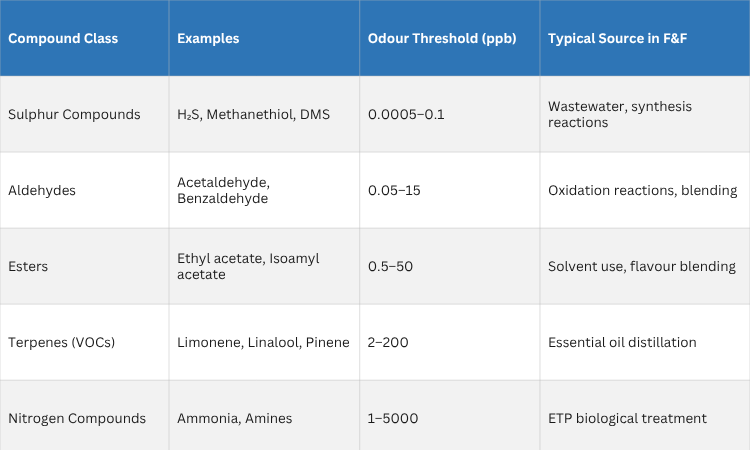
Odour emissions from most processes are due to the high volatility and abundance of these compounds. The effect of these substances in the air may change due to the interaction of temperature, pressure, and the interaction of systems, and high dynamics in the processes.
The presence of these substances usually indicates processing of chemicals or use of incomplete chemical reactors as a result of their strong odour intensity, high toxicity, and relatively strong odour-active properties.
Esters are important for creating flavors. Problematic concentrations are those present in most industries. They cause odor nuisance even when their pleasant nature is considered.
Sulphur compounds are important given their extremely low odour thresholds. A small leak is enough for the world to smell. Methanethiol and dimethyl sulphide, for example, can be detected at sub-parts-per-billion concentrations.
Commonly found in wastewater systems, these compounds, as the name suggests, contribute sharp and persistent odours which are of concern and require targeted treatment strategies.
The first step in odour control is to capture the emissions at their source. This encompasses the design of hoods, enclosures, and duct systems that stop the free release of emissions while ensuring that the air is directed to the treatment units. Some of the important design strategies include:
The following table provides a summary of the main technologies for odour control, the range of activities they are used for, and their operational performance:
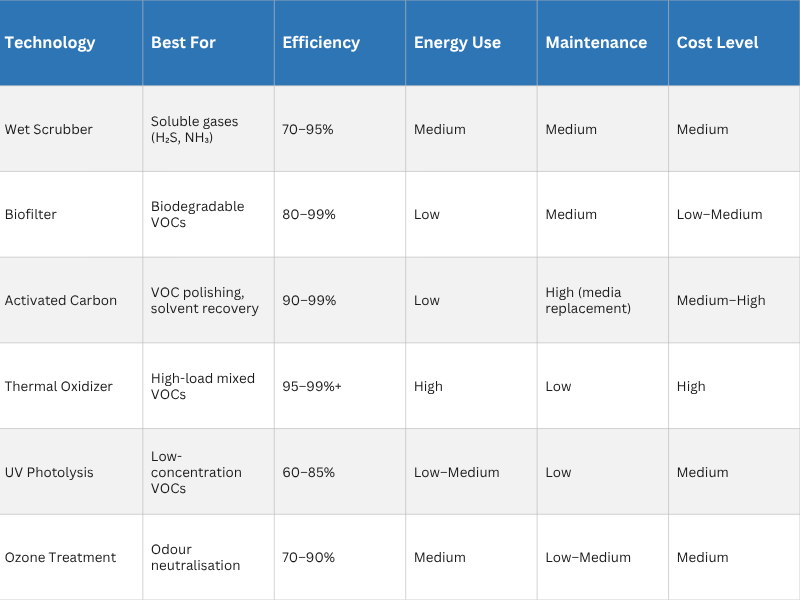
Packed-bed wet scrubbers are commonly used for reactive and soluble F&F odour control. Single-stage alkaline scrubbers (NaOH solution) work well for vapour streams containing aldehydes and acids. Dual-stage scrubbers with an acidic scrub for ammonia, followed by an alkaline scrub for sulphur and acid gases, are useful for streams typical of ETP exhausts. Scrubber systems with multiple stages, advanced reagent dosing, and pH-controlled automation can achieve removal efficiencies of between 90-99% for the compounds of concern.
Biofilters use packed beds of organic or inert media to house the microbial population that oxidises odour compounds as an energy source. Biofiltration is cost-effective for odour control with high volumetric, low to moderate concentration streams, like the exhaust gases from the blending hall F&F and from the ETP area extraction. Well-designed biofilters can achieve a 90-99% removal of VOCs (Biodegradable esters, alcohols, and terpenes) with very little energy consumption. Probably the best choice for a mixed stream of organic and inorganic compounds, the Biotrickling filter, is preferred due to better process control.
For F&F facilities that deal with large amounts of solvents, solvent recovery serves as a dual-purpose odour control and economic gain. Recovery systems can consist of:
Recovered solvents undergo quality assessment before being reintegrated into the system. This enables the application of the necessary capital for control equipment and operation cost recovery.
Regenerative Thermal Oxidizers (RTOs) operate by combusting odorous VOK and sulfur compounds at temperatures between 800 – 1,000 °C, and transform them into CO2 and H2O. They have destruction efficiencies of over 99%. RTOs retain 90 – 95% of the heat of combustion, which reduces the operating costs of combustion of high temperature heat. Diathermic uses of thermal combustion units is for high concentration solvents.
Odour molecules can be degraded by short-wave UV light, 185 nm and 254 nm, and photolytic odour destruction UV systems. When used with ozone injection, the oxidation efficiency is considerably enhanced. These odour control devices are employed most effectively for
Keeping ozone levels preferably below the occupational exposure levels (which is usually about 0.1 ppm TWA) odour neutralizing Ozone systems can be used without issue in closing spaces such as storage and filling halls.
Real-time monitoring for early detection of exceeding boundaries for a fast response is a critical component for modern odor management. Crucial technologies include:
No single technology can be used to address all emission types. Many modern plants now utilize hybrid systems that integrate multiple treatment steps for greater operational flexibility and efficiency. For a source capturing F&F Plant, for example, a hybrid configuration could include a wet scrubber for sulphur and ammonia removal, a biofilter for VOCs, and an activated carbon polishing step.
An odour control system requires an understanding of processes, emissions, and the environment. A well-structured design will have the following steps:
The airflow design determines the effectiveness of source capture. Key parameters include:
Modern odour control systems become part of the plant’s automated systems. They include:
Operational reliability is determined by regular maintenance, monitoring, and optimization. Even the best systems will fail, if not managed well. A lifecycle approach incorporates:

Just because you are compliant with stack emissions does not protect the community. Odour effect is determined not only by emission concentration but also by dispersion in the atmosphere with respect to local meteorological and terrain conditions, as well as the sensitivity of odour receptors. Now, dispersion modelling helps to fill the gap between what a plant actually emits and what communities see.
The most common regulatory dispersion models for odour impact assessment are:
The modelling output — normally given in terms of hourly odour concentration at receptor points (in the 98th or 99th percentiles) — is evaluated against guideline values (e.g., EU frameworks may use values of 1–5 OU/m³ at residential receptors) as an indication that its compliance has been demonstrated.
Dynamic olfactometry (EN 13725) It is an internationally adhered standard for assessing odour concentration. In this method, diluted samples of odour-bearing air are tested by trained human panels. The units of odour concentration is European Odour Units expressed in terms of volume per cubic metre (OU/m³) where one OU corresponds to the dilution factor at which 50% of the panel detects the respective odour. Olfactometry is used to:
According to modelling results, facilities must establish a minimum separation distance (buffer zones) to sensitive receptors centres or that demonstrate from the emission source eg residential property, educational institutions, hospitals and leisure areas. Expanded treatment is needed to bring emissions low enough, where buffer zones are unable to be enlarged.
More recent odour control strategies in food flavour and fragrance manufacturing must be built on fundamental principles that are consistent with Indian potable water supply regulations and international best practices. Odour is primarily regulated indirectly through environmental regulations in India, but increasingly defined as a quantifiable and enforceable parameter internationally, with applicable international frameworks (involving standardised testing based on odour characterisation and modelling to ensure compliance) finding use.
In India, people have to deal with smells as part of cleaning up the air. The Central Pollution Control Board and State Pollution Control Boards make sure everyone follows the rules. They use laws like the Air Act of 1981 and the Environment Act of 1986 to do this. These laws let the authorities control what comes out of factories, give permits to companies, and punish industries that do not follow the rules. The Central Pollution Control Board and State Pollution Control Boards are very important in making sure industries do not make the air smell bad.
While some regions in the world issue numeric odour limits defined by odour units (OU/m³), as a general principle, this is not mandated for India. Odour is not addressed directly; emissions of VOCs, hazardous air pollutants, and odorous compounds are managed indirectly through ambient emission standards and limits established for specific processes. A general condition that applies to all industries is that operations must not cause ‘odour nuisance’ outside plant boundaries.
Industries are going to have to set up monitoring programmes. These programmes will include testing the air coming out of their stacks and finding ways to control emissions that escape. The people in charge are also putting in systems to keep an eye on these industries all the time.
The way authorities make sure industries follow the rules is changing. They used to take action when someone complained. Now they are taking a look at industries that deal with chemicals, food, and flavourings. They are doing checks to make sure these industries are following the rules.
India is changing the rules about smells. The people in charge are paying attention to how bad smells affect people. They are doing studies on smells and making sure that factories are designed to reduce bad smells. They are also setting up systems to control smells in industries that bother people who live nearby, like the Indian odour management practices and the Indian odour control systems. Authorities in India are focusing on India’s odour assessment studies to make things better.
The Clean Air Act is what the United States uses to deal with odour issues, and the Environmental Protection Agency (EPA) makes sure it is followed. The main focus of the government is on VOCs and hazardous air pollutants, so the states and local governments handle odour issues. A lot of states have laws about nuisances. They make industries come up with plans to reduce odours when they release a lot of emissions.
The European Union has an organized way of doing things. The Industrial Emissions Directive (IED) tells industries what they have to do, such as using the techniques available and having good plans to manage odours. They measure odours using EN 13725, which gives them a number for how bad the odours it is, called odour units per cubic metre.
What is interesting is that the focus is not just on how much is being emitted but on how it really affects people. Here, people use computers to see how odours spread from factories to homes. They set limits for how much odour people can be exposed to, especially in areas where people live.
Countries like the United Kingdom, Germany, Australia, and New Zealand have detailed guidelines. They watch what is happening, use computers to predict what will happen, and ask the community what they think. Their rules often say that industries have to have areas around them where they cannot build, they have to check for odours, and they have to have plans for managing odours so they can be held responsible.
India usually deals with odour in a certain way. They use general rules about emissions and laws about nuisances instead of specific rules about odour. In countries, odour is something that can be measured, and there are clear limits and ways of measuring it, like dynamic olfactometry (EN 13725), that are part of the rules. India has not widely used these methods yet. The rules are not enforced evenly. Instead of waiting for people to complain, other countries use computers to predict what will happen. They watch what is happening all the time, and they plan to prevent odour problems, which is different from India, Global Regulatory Practices, and Global Practices.
Regulators around the world are shifting from vague, qualitative odour management to methods you can actually measure. They’re starting to use real-time monitoring tools and smart data analytics to track odours with precision. Odour Management Plans, or OMPs, are becoming standard — these plans bring together how a process works, the strategies to control odours, and ongoing performance checks. In India, you can see the same change starting to happen, especially in industries located near communities that are more vocal and where environmental standards are getting tighter.
An Odour Management Plan, or OMP, lays out how a facility handles odour—everything from spotting potential sources to controlling them, keeping an eye on emissions, and dealing with any problems that pop up. In India, you won’t find OMPs as a legal requirement just yet, but in the European Union, they’re necessary because of strict regulations. And in places like the UK, Australia, and New Zealand, regulators expect facilities to have one ready. Even if it’s not the law where you are, having a solid OMP shows you’re serious about managing odour. It really helps if you ever face community complaints or get extra attention from the authorities.
A comprehensive OMP for an F&F manufacturing facility should include the following components:
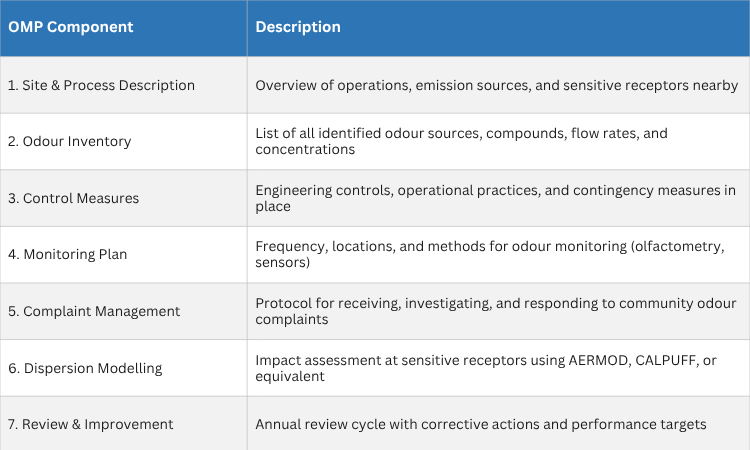
For food flavour and fragrance manufacturers, an OMP should specifically address the dynamic nature of production — including batch versus continuous processes, seasonal variations in ambient conditions, and planned shutdown/start-up scenarios which often represent peak emission events. The OMP should be reviewed and updated whenever significant process changes occur or following any sustained community complaint incident.
Elixir Enviro Systems Pvt. Ltd. (EES), headquartered in Calicut, Kerala, is one of the most experienced environmental engineering firms in South Asia for industrial odour control. Founded in 2014, EES brings over seven decades of combined leadership expertise in environmental pollution control and has delivered air treatment systems with a cumulative capacity of over one million cubic metres per hour across diverse industrial sectors — including food processing, chemical manufacturing, rubber processing, distilleries, and wastewater treatment.
EES does not apply a one-size-fits-all approach. The company’s methodology begins with rigorous emission characterisation before selecting and engineering the most appropriate solution. For F&F applications, EES deploys:
EES’s methodology uses modelling, pilot studies, and onsite assessments to design systems that achieve measurable performance outcomes. Every EES system is specified with guaranteed performance parameters, and installation documentation provides the evidence base required for ESG reporting, ISO 14001 audits, and regulatory compliance demonstration.

Odour isn’t just something food, flavour, fragrance, and additive manufacturers need to keep under control for smooth operations anymore. These days, it’s front and center in showing how committed a company really is to Environmental, Social, and Governance (ESG) standards. People—investors, customers, regulators, everyone in the neighborhood—look at how a facility handles smells as a shortcut for judging their priorities: are they serious about sustainability, worker health, and following the rules openly? Investing in advanced odour control isn’t just about what happens inside the factory gates. It boosts a company’s ESG reputation in a very real way.
Good odour control does a lot more than just stop smells. It actually helps the environment. Fits in with our goals for the climate and air quality.
Let us look at this in detail:
In short, controlling odour is not about following rules. Odour control is about making a difference to the environment. Effective odour control is about making a difference to the environment.
Good odour control systems do a lot more than just keep a factory smelling nice. They also protect the people who work inside the factory. They keep the people who live in the surrounding community happy with you.
When we talk about governance, a good odour control program does a lot more than just control smells. It helps us build the kind of evidence that investors, auditors, and regulators want to see.
First, we get to comply with regulations. Whether we need to submit data from stack tests or show our Odour Management Plans, we are covered in India with CPCB/SPCB standards and abroad with frameworks like the EU Industrial Emissions Directive.
So odour control is not about following rules. It is a way to improve our ESG value. Instead of treating it as a problem, we can use odour control to run our operations more cleanly, build stronger relationships with our community, and show that we have good governance. Odour control helps us do these things. It is very important for odour control to be a part of our overall plan.
Controlling odour in food flavour and fragrance manufacturing isn’t simple—it pulls together chemistry, engineering, and environmental science. You really have to know where emissions are coming from, even the sneaky fugitive ones people tend to miss. It means picking the right technology, building solid systems, and keeping real-time monitoring in place, all backed by a strong Odour Management Plan. That’s how companies stay on top of odour, stay safe, keep things sustainable, and meet regulations. Money’s part of the picture too. Smart odour control doesn’t just tick compliance boxes—it saves money through things like solvent recovery, sidesteps costly fines, and helps companies avoid a hit to their reputation. Plus, it lines up with those ESG goals everyone talks about—something customers and investors actually care about now. As laws tighten and the public pays more attention, staying ahead with odour management is just part of running a responsible operation in the flavour and fragrance industry. It’s not just good practice—it’s expected.
It is about the volatile compounds that get released into the air. Whenever people handle solvents, run reactions, distill, blend, or treat wastewater, food flavour and fragrance manufacturing compounds escape into the air. This includes things like VOCs, aldehydes, esters, sulphur, and nitrogen-based compounds. Many of these food flavour and fragrance manufacturing compounds smell bad even when there is any in the air.
Industrial odour is measured using both sensory and instrumental methods. The most widely accepted technique is dynamic olfactometry (EN 13725), where trained human panels determine odour concentration in odour units per cubic metre (OU/m³). Gas analysers and VOC sensors are used for real-time monitoring of specific compounds such as hydrogen sulphide, ammonia, and total VOCs. Electronic nose systems provide continuous boundary monitoring.
There is no single universal technology for odour control. The effectiveness depends on the type of compounds, concentration levels, and process conditions. Wet scrubbers are suitable for soluble gases, biofilters are effective for biodegradable compounds, activated carbon systems are used for VOC adsorption, and thermal oxidizers are applied for high-concentration emissions. In most cases, a combination of technologies — as illustrated in the technology comparison table — is required.
Many fragrance compounds are designed to be pleasant at very low concentrations. However, during manufacturing, these compounds are present in high concentrations and often mixed with reactive intermediates or solvents. This results in intense, complex odours that can become overwhelming, irritating, or even hazardous at an industrial scale.
Think of it as your facility’s plan for dealing with smell. It is how you find the smell, control it, keep track of it, and respond when something goes wrong. In the European Union, you must have one, no questions asked. A lot of countries are starting to follow this rule. Even in places like India, where the law does not require having a plan to manage smells, it shows you care about the environment. This is especially important if your site is close to a neighborhood. It also matters if you are getting complaints about the smell.
The choice depends primarily on the compounds present. Biofilters excel at treating biodegradable VOCs (terpenes, esters, alcohols) at low to moderate concentrations and offer low operating costs. Chemical scrubbers are better suited to highly soluble, reactive, or non-biodegradable compounds (H₂S, NH₃, certain aldehydes) and can handle high-concentration peaks more reliably. Many F&F facilities use both in series.
Biofilters work really well for getting rid of smelly, biodegradable stuff—mostly from wastewater treatment and places with low to moderate VOCs. If you don’t design them right, keep the moisture in check, and stay on top of maintenance, they just won’t deliver. And most of the time, you’ll see biofilters teamed up with other technologies, not running solo.
In India, odour control doesn’t have one clear rulebook. There aren’t set odour limits everywhere, but industries still have to follow standards for VOC emissions and make sure their smells don’t bother the neighbours outside their plant.
Yes, odour complaints can still arise even when emissions comply with regulatory limits. This is because odour perception depends on human sensitivity and odour thresholds, which can be much lower than regulated concentration limits. Therefore, odour management must consider both compliance and community impact — which is why dispersion modelling and OMP preparation are important complements to emission measurement.
Olfactometry (EN 13725) is the laboratory-based measurement of odour concentration using trained human assessors. You should commission olfactometric testing when characterising emission sources for a dispersion model, verifying odour control system performance, responding to a formal regulatory request, or establishing a baseline before installing new treatment equipment.
To get results for a long time, you need a system that is well-designed. You also have to take care of it and keep an eye on it all the time. You have to check how well it is doing now and then. Things like how much air is moving, how clean the filters are, how hot or cold it is, and how humid it is all need to be kept in check. This is so the system can keep treating things. An Operations and Maintenance Plan, or OMP for short, that is reviewed on a regular basis, helps make sure everything runs smoothly. The OMP has a schedule for checking everything, which makes sure the system keeps working overtime.
Elixir Enviro Systems gives people solutions to control bad smells. They do everything from figuring out what the problem is to designing a system and picking the technology. They even install it. Make sure it works as well as it can. The company is really good at cleaning the air and water. So they can give people solutions that’re just right for them. These solutions deal with tough smell problems. They also make sure people follow the rules and do what is best for the environment. Elixir Enviro Systems does all of this with Elixir Enviro Systems expertise, in air and wastewater treatment.

After installation of EES’ Cocofil biofilter, the complaints regarding fishy odour from the factory has diminished. The system is working well with very low operation cost as well as better efficiency as compared to our previous odour control unit.
The system is in operation since 2020
DGM, Avanti Feeds Ltd, Gujarat

EES is our trusted partner in the odour control and wastewater treatment. They have installed the odour control unit consisting of different scrubbers, biofilters and a Biological Nutrient Removal based ETP. There were instances where we had faced near to closure, but EES’s support helped us a lot. Currently EES has been given operation contract for the Odour Control Unit and for the Effluent Treatment Plant
The System is in operation since 2017.
Managing Partner, Collagen Marine Products, Kerala
Elixir Enviro Systems has installed two Biofilters at our ossein plant in 2015 and 2017 respectively. EES has demonstrated the odour removal efficiency in our presence with over 98% odour removal. We thank you for your support.
Sr Manager, Kerala

Elixir Enviro System has done the installation and commissioning of Biofilter based Odour control system for Feed manufacturing unit at Orisa in 2017. The work has been completed in accordance with the Work order. We have also witnessed an odour removal efficiency of over 99%.
AGM, Falcon Feeds, Orrisa